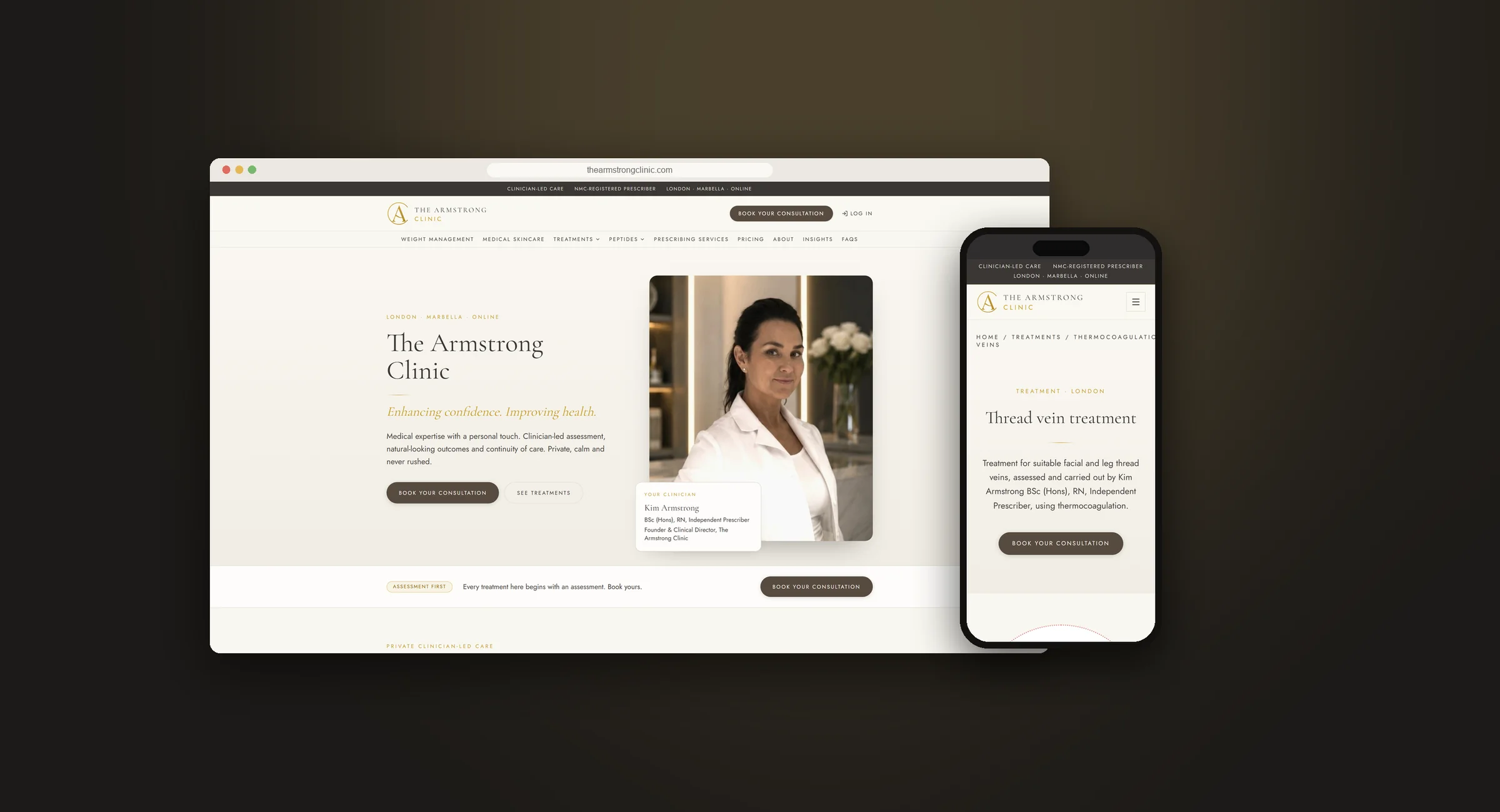
Most clinic websites are a brochure with a booking widget bolted on. That works well when every treatment is booked the same way: pick a service, pick a time, pay. Many private clinics don't work like that. Some treatments need a consultation first. Some need a clinical decision before anything else can be booked. Some happen online, some in person, some on someone else's premises. When the booking tool can't see any of that, the rules end up in the clinician's head and the admin ends up in their evenings.
Four services, four patient journeys, one diary
The Armstrong Clinic is a one-clinician practice. Kim Armstrong is a registered nurse and Independent Prescriber, treating patients in London, in Marbella and online, and prescribing on behalf of other clinics. Each of her four services is booked differently.
Thread veins and skin lesions need an online consultation, a clinical approval, and only then an in-person treatment slot. Medical skincare is consultation only, followed by a prescribed product plan the patient orders themselves. Weight management runs through a regulated prescribing and pharmacy partner, OxygenRX. Prescribing services are sold to other practices, not patients.
An off-the-shelf booking tool handles one of those well. The practice needed all four, sharing one diary and one clinician.
Sign one: your diaries have rules between them
Kim works from two diaries: online video consultations, and in-person treatment sessions in London. Two in-person appointments can sit back to back. An online consultation and an in-person treatment need two clear hours between them, in either order, for travel and for an appointment that runs over.
A general booking tool has no way to know that. We built the rule into the database itself, checked inside a single transaction at the moment a slot is claimed. Two patients booking within seconds of each other can't both win, even when they're claiming different slots in different calendars.
"A booking system should know a clinician can't be in two places at once."
Sign two: some appointments shouldn't be bookable yet
When a treatment depends on a clinical decision, letting patients book it straight away creates work: appointments to cancel, refunds to issue, awkward conversations. At The Armstrong Clinic, thread vein patients are gated by clinical approval before they can choose an in-person slot. The clinician decides, and the system follows.
Sign three: you chase unpaid bookings
On the clinic's platform a slot is held the instant a patient submits, released automatically after thirty minutes if they abandon payment, and a booking only exists once its consultation fee has cleared. There's nothing to reconcile. If it's in the admin panel, it was paid for.
Patients also cancel or reschedule their own appointments from their account, up to twenty-four hours before, and keep their bookings, skincare plan and invoices in one place.
Sign four: details are retyped into another system
If patient details have to be copied from your booking tool into a prescribing or records system, every copy is a chance for an error. For weight management, the clinic's assessment form is fetched live from OxygenRX. When a patient submits it, the platform finds or creates them as an OxygenRX patient and writes their answers straight onto their record. Nothing is typed twice.
Every submission also arrives with a suggested verdict and the reasons behind it, worded as a prompt rather than a decision, because the prescribing decision belongs to the prescriber.
Sign five: other clinics book your time by email
Kim also attends partner practices that have no Independent Prescriber on the team. That used to mean emails, spreadsheets and patient lists retyped by hand. Now she publishes the days she's willing to travel, and each practice signs in to its own portal, books a day, adds its patients and gives them a time. Booking a clinic day closes her own calendars around it, with the same two-hour gap either side.
Rules written in code, and tested
When the rules matter clinically, they need to be enforced where they can't be bypassed and checked so they stay that way. The Armstrong Clinic platform has 182 automated tests guarding its booking, eligibility and payment rules. That's what lets one clinician trust the system with the parts of the day she'd otherwise have to police herself.
None of this replaces clinical judgement. The point of building it properly is that the clinical decisions stay with the clinician, and everything else simply works.
Is a custom booking system right for your clinic?
If every treatment is booked the same way, a good booking widget is probably all you need. It's worth considering a custom system if you run several services with different journeys, work across more than one diary or location, need clinical approval before some bookings, rely on a prescribing or records partner, or sell your time to other practices.
Our custom software development page explains how we approach builds like this, and the Armstrong Clinic case study shows the whole platform, from the public website to the partner portal.
If your booking tool handles one of your services well and the rest by hand, tell us how your clinic actually runs. Discovery costs nothing, and we'll give you an honest view on whether a custom system is worth building.
Start the conversation →